June in San Jose has its own rhythm. Soccer cleats by the back door. Helmets are charging in the garage. A family calendar that runs from early morning Little League games to late afternoon mountain bike rides through Almaden Quicksilver. Summer sports are one of the best parts of childhood: the teamwork, the competition, the confidence that comes from pushing physical limits.
But with that increase in activity comes a risk that most parents don’t think about until it happens: dental trauma. Knocked-out teeth, fractured enamel, soft tissue lacerations, and jaw injuries are among the most common sports-related injuries in children and adolescents — and unlike a sprained ankle, dental injuries left unaddressed can have permanent consequences for a developing smile.
The good news is that the right preparation makes most of these injuries entirely preventable. Here’s what every San Jose parent needs to know before the summer season kicks into gear.
The Problem with the $10 Sporting Goods Store Mouthguard
Walk into any sporting goods store, and you’ll find a wall of boil-and-bite mouthguards priced between $10 and $30. Most parents pick one up before the season, consider the box checked, and move on. It’s an understandable choice; convenient, affordable, and provides some level of protection. The problem is that “some level” is doing a lot of work in that sentence.
Boil-and-bite guards are made from a single layer of thermoplastic material that softens in hot water and roughly conforms to the teeth when the child bites down. The result is a guard that is bulky, often uneven in thickness, and never a precise fit. Kids find them uncomfortable to wear. They make it harder to breathe during a sprint and nearly impossible to communicate clearly with teammates mid-game. The predictable outcome is that the guard spends most of the season in a gear bag pocket rather than in a mouth.
A mouthguard that isn’t being worn provides exactly zero protection.
The 2026 gold standard for youth sports dental safety is the custom pressure-laminated mouthguard, and the difference between this and a store-bought version is not subtle — it’s the difference between a tool designed for your child’s unique anatomy and a generic placeholder that was never really built for them.
Why Custom Pressure-Laminated Mouthguards Are in a Different Category
Custom sports mouthguards from a dental specialist are created using high-heat pressure lamination. A process that bonds multiple layers of protective material together under controlled heat and pressure, then molds the result precisely to a 3D digital scan of your child’s teeth.
The layered construction is the key. Multiple laminated layers of varying density can be engineered to absorb and disperse impact energy far more effectively than a single layer of boil-and-bite plastic. The outer layer resists direct impact. The inner layers compress and spread force across the entire surface, reducing the concentrated energy that causes tooth fractures, root damage, and jaw injuries. The result is a guard that is simultaneously thinner, more comfortable, and dramatically better at doing its actual job.
Because the guard is molded from a precise digital impression of your child’s teeth, it fits like a second skin — stable during contact, secure enough that it won’t shift during a collision, and comfortable enough that kids actually keep it in. Athletes can breathe deeply through a full sprint and communicate clearly on the field without adjusting or removing the guard.
The protection also extends beyond the teeth themselves. A well-constructed custom guard acts as a shock absorber for the entire jaw, reducing the transmission of impact forces that can cause jaw fractures, temporomandibular joint injuries, and soft tissue lacerations from teeth cutting the inside of the lips and cheeks. For kids playing contact sports in summer leagues across San Jose, whether that’s soccer at Blossom Hill, youth football, or any other high-impact activity, that full-system protection matters.
The Knocked-Out Tooth Procedure:
No mouthguard eliminates all risk, and accidents happen even to the most prepared athletes. If your child takes a hit and loses a permanent tooth, the next 30 to 60 minutes are critical. Knowing the correct procedure for a knocked-out tooth before you ever need it can be the difference between saving the tooth and losing it permanently.
Step 1: Stay calm and locate the tooth.
Pick the tooth up by the crown (the visible white chewing surface) only. Never touch the root. The root surface contains periodontal ligament cells, making successful re-implantation possible. Even a few seconds of handling the root with dry fingers can damage or kill those cells.
Step 2: Rinse gently if needed — nothing more.
If the tooth is visibly dirty, rinse it very briefly under clean water or with cold milk. Do not scrub it, do not use soap or disinfectant, and do not wrap it in a tissue or cloth. Scrubbing or drying the tooth destroys the root surface cells you’re trying to preserve.
Step 3: Re-implant immediately if possible.
If your child is calm enough and it is a permanent tooth, gently guide the tooth back into the socket in its correct orientation and have your child bite down softly on a clean cloth to hold it in place. This is the best possible environment for the root surface cells to survive.
Step 4: If re-implantation isn’t possible, use the right storage medium.
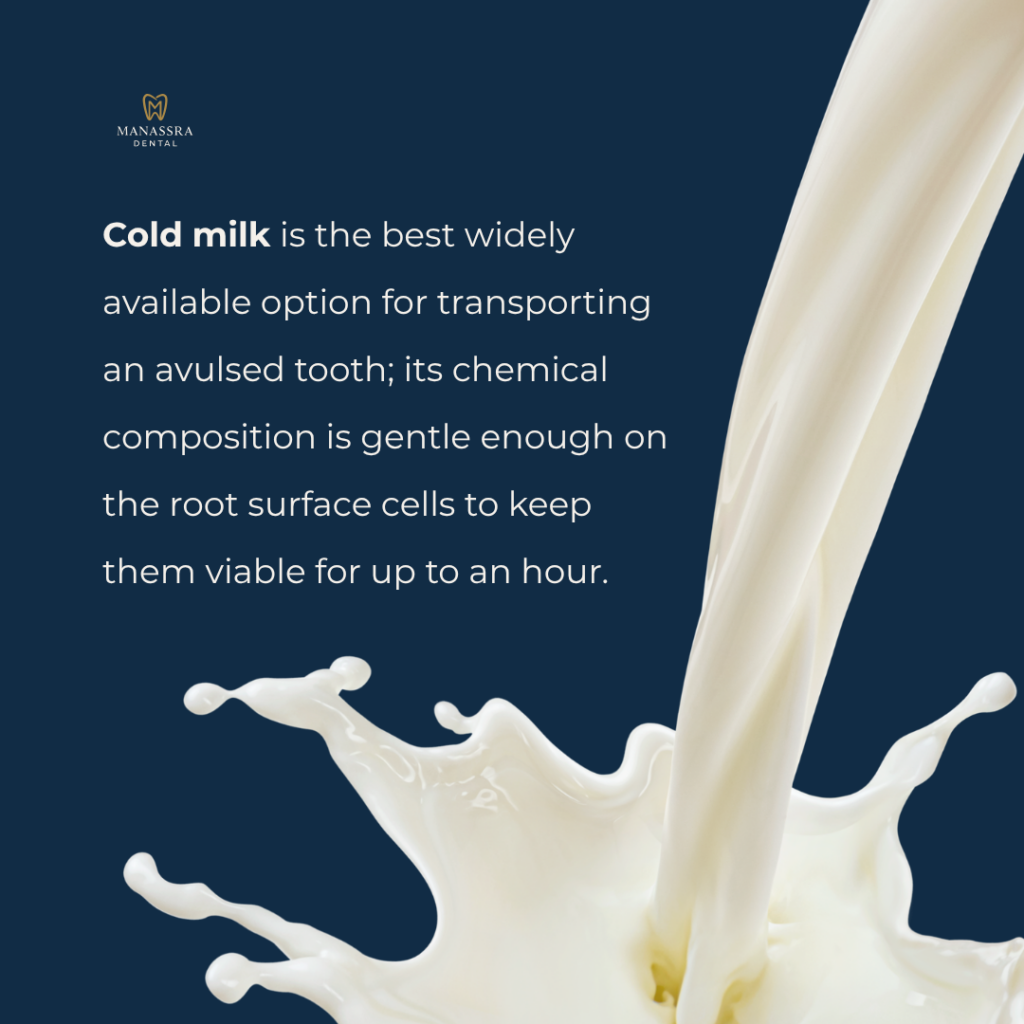
Cold milk is the best widely available option for transporting an avulsed tooth; its chemical composition is gentle enough on the root surface cells to keep them viable for up to an hour. Saliva (keeping the tooth tucked inside the cheek, if the child is old enough to do so safely) is also acceptable. Do not use tap water, its salt concentration is wrong for keeping root cells alive.
Step 5: Get to an emergency pediatric dentist in San Jose immediately.
The 30-minute window is not an estimate; it is the clinical threshold after which the success rate of re-implantation drops sharply. Call ahead so the office can prepare for your arrival. Do not go to a hospital emergency room first; most ERs are not equipped to re-implant teeth, and the time spent there is time the tooth cannot recover.
One important note: this protocol applies only to permanent teeth. If a baby tooth is knocked out, do not attempt to re-implant it. Forcing a primary tooth back into the socket can damage the developing permanent tooth underneath. Contact a pediatric dentist for guidance, but it is generally not an emergency in the same way.
Dental Trauma First Aid: Building It Into Your Team’s Routine
One of the most practical things any youth sports parent or coach can do this summer is add a simple dental trauma kit to the first-aid bag. A Save-A-Tooth kit, a small container of pH-balanced Hank’s Balanced Salt Solution designed specifically to preserve avulsed teeth, is the ideal storage medium and costs only a few dollars. It keeps root cells viable significantly longer than milk and eliminates the scramble to find an appropriate liquid in a chaotic sideline moment.
Beyond the kit, make sure at least one parent or coach per team has reviewed the procedure and knows the number for an emergency pediatric dentist in San Jose before the season starts. Dental trauma first aid is simple enough to execute under stress if you’ve run through it mentally in advance. It’s nearly impossible to learn for the first time in the moment.
The Manassra Dental Difference: Specialist Care for Developing Smiles
Treating dental trauma in children is not the same as treating it in adults, and the distinction matters enormously. Children’s teeth are still developing. Root structures are not always complete. Permanent teeth are still erupting beneath primary ones. A sports-related injury that might be straightforward to treat in a 35-year-old can have cascading effects on a child’s developing dentition if not managed with pediatric expertise.
At Manassra Dental, we approach youth sports dental safety with that developmental context at the center of every decision. Our custom mouthguards are created using the same 3D scanning technology we use for our advanced prosthodontic work — a level of fit precision that isn’t achievable with any over-the-counter product. For children currently in orthodontic treatment, we design custom guards to fit over brackets, protecting both the teeth and the soft tissue of the lips and cheeks from metal-contact injuries during impact.
We also understand that dental emergencies don’t schedule themselves. Our office is set up to respond to urgent dental trauma cases with the speed and specialist capability that these situations require.
Frequently Asked Questions
For growing kids and teens, yes. As the jaw develops and new permanent teeth erupt, even a well-fitting custom guard can become loose or fail to cover new teeth adequately. We recommend an evaluation before each major sports season to assess fit and make any necessary updates.
For a knocked-out permanent tooth, call a pediatric dental specialist first. Most hospital ERs do not have the equipment or training to re-implant teeth, and every minute spent in a waiting room reduces the chance of successful re-implantation. Get to a dental office as fast as possible.
Yes — and it’s actually more important that they do. Orthodontic brackets can cause serious lacerations to the lips and cheeks during impact. We fabricate custom guards designed to fit over the entire bracket system, providing full protection for both teeth and soft tissue.
Any child playing a contact or collision sport, typically from age six or seven onward, benefits from a properly fitted mouthguard. The custom option becomes especially important once permanent teeth begin erupting, as those teeth cannot grow back if lost or severely damaged.
Play Hard. Stay Protected.
Summer sports are about building skills, confidence, and memories that last a lifetime. A dental injury shouldn’t be part of that story, and with the right preparation, it doesn’t have to be.
A custom pressure-laminated mouthguard is a small investment compared to the cost of emergency dental care, and it’s an even smaller price to pay compared to the long-term consequences of losing a permanent tooth during a child’s developmental years. Pair that with a basic understanding of dental trauma first aid, and you’ve done everything within your power to protect your athlete before they step onto the field.
Is your child ready for the summer league? Contact Manassra Dental today to schedule a 3D scan and get a custom sports mouthguard built for your athlete’s unique anatomy. Let’s make sure their smile is as strong as their game.