The Transition Back to Routine
September 2026 marks a natural shift in pace across the South Bay. As summer vacations wrap up and the autumn back-to-work routines take full effect, our attention naturally returns to self-care, health goals, and managing lingering physical needs that we may have put on the back burner during the active summer months. Between summer travel up the coast, family outings, and busy work schedules, it is easy to ignore subtle signs that your dental health needs attention. Autumn brings a clear opportunity to reset, take stock of your oral health, and complete necessary structural upkeep before the rapid pace of the end-of-year holidays sets in.
The Warning Signs of Failing Hardware
This transitional period is the smartest time to evaluate your existing dental hardware. Perhaps you have an older dental crown that feels slightly loose when you chew, a dark line showing along your gumline, or a heavily decayed back tooth that twinges every time you drink cold water. You might notice food getting continuously caught between specific teeth, a minor crack visible on a molar, or a dull ache after enjoying a hot morning coffee or an iced drink.
Ignoring these minor structural warning signs now can easily turn into a painful dental emergency right in the middle of the busy upcoming holiday social season. A small crack left untreated under constant chewing pressure can suddenly break, requiring urgent intervention when schedules are tightest and family commitments are at their peak. Proactive care ensures your bite remains comfortable, strong, and trouble-free.
Reinforcing Your Smile’s Foundation
Reinforcing a structurally compromised tooth requires a restorative material that can withstand incredible biomechanical force over several decades. By understanding how a time-tested porcelain-fused-to-metal framework works, you can make an informed decision to restore your full chewing capacity and protect your smile’s long-term health.
At Manassra Dental, our priority is combining advanced structural engineering with precision aesthetics, ensuring that every restoration we place delivers maximum longevity, complete comfort, and absolute peace of mind for our San Jose patients.
The Engineering of a PFM Crown
The Best of Both Worlds
When a back molar is severely cracked or broken down by deep decay, a standard dental filling can no longer provide adequate protection. Large fillings lack the structural integrity to hold a compromised tooth together under heavy forces; over time, they can act like a wedge, increasing the risk that the remaining natural tooth walls will split.
In these scenarios, a porcelain-fused-to-metal crown (frequently called a PFM crown) serves as an incredibly dependable and structurally sound solution. Designed to completely encase the visible portion of the tooth, a PFM crown redistributes biting forces evenly, restoring structural stability while protecting the remaining natural tooth beneath.
The Layered Architecture
The enduring success of PFM technology lies in its unique hybrid engineering. The restoration is built in two distinct layers:
- The Interior Core (Metal Coping): A custom-milled precious or base metal alloy sleeve fits directly over your prepared natural tooth structure. This metal infrastructure provides unmatched tensile strength and flexibility, preventing the crown from cracking under immense pressure.
- The Exterior Shell (Porcelain Overlay): High-strength dental porcelain is meticulously baked and fused over the metal core in a high-temperature laboratory furnace. This exterior layer is custom-shaded to match your surrounding enamel, giving the restoration a completely natural appearance.
This multi-layer construction resolves a long-standing challenge in restorative dentistry: strength versus beauty. Pure metal crowns, while exceptionally strong, lack natural aesthetics. Pure porcelain or traditional glass-ceramics offer excellent translucency but historically lacked the structural support necessary for heavy load-bearing zones. The PFM design combines the raw fracture resistance of a metal substructure with the natural shade, texture, and light-reflecting qualities of dental porcelain.
Engineered for Back Molars
Your back molars bear the brunt of your daily chewing forces, enduring up to 200 pounds of pressure per square inch during normal function. Nighttime teeth grinding (bruxism) or clenching can elevate these stresses even higher. While all-ceramic restorations look beautiful on front teeth, the metal backing of a PFM crown makes it uniquely qualified to handle heavy posterior chewing loads without fracturing, offering an exceptionally reliable track record that spans over fifty years of clinical use.
The metal framework acts as an internal shock absorber, allowing the crown to flex minutely under catastrophic biting forces rather than snapping or shattering. For patients with a history of heavy chewing, strong jaw musculature, or extensive dental bridges spanning long gaps, the structural safety margin provided by a PFM crown remains an elite standard in structural restorative dentistry.
Protecting the Vital Foundation — The Root System
The True Goal of a Dental Crown
While a crown is often discussed in terms of its visible surface appearance, its most critical job happens entirely out of sight. A properly engineered and well-fitted crown acts as an airtight, protective helmet designed to completely seal and shield the underlying tooth root from the harsh environment of the mouth. The visible white enamel of your tooth is merely the outer shield; true dental health depends on maintaining the integrity of the root system embedded beneath the gums.
Preventing Bacterial Seepage
Your tooth root is anchored deep within your jawbone, housing the delicate living nerve tissues and blood vessels (the dental pulp) that keep the tooth alive and hydrated. When dental decay or a structural fracture breaks through the protective outer enamel, it opens up a microscopic pathway for aggressive mouth bacteria to migrate downward toward the root.
Bacteria feed on food particles and reproduce rapidly in dark, warm environments. Once they penetrate the protective layer of dentin beneath your enamel, they move swiftly toward the central nerve chamber. Without a durable, custom-milled seal protecting the top of the tooth, bacterial seepage will continually degrade internal tooth structure, compromising the foundational stability of the entire root.
Halting the Cascade of Infection
If bacteria successfully breach this inner chamber, they will cause a painful root infection or a localized bone abscess. Once an infection reaches the apex of the root system, the delicate nerve tissue dies, often resulting in severe pain, facial swelling, and irreversible loss of supporting jawbone density around the tooth.
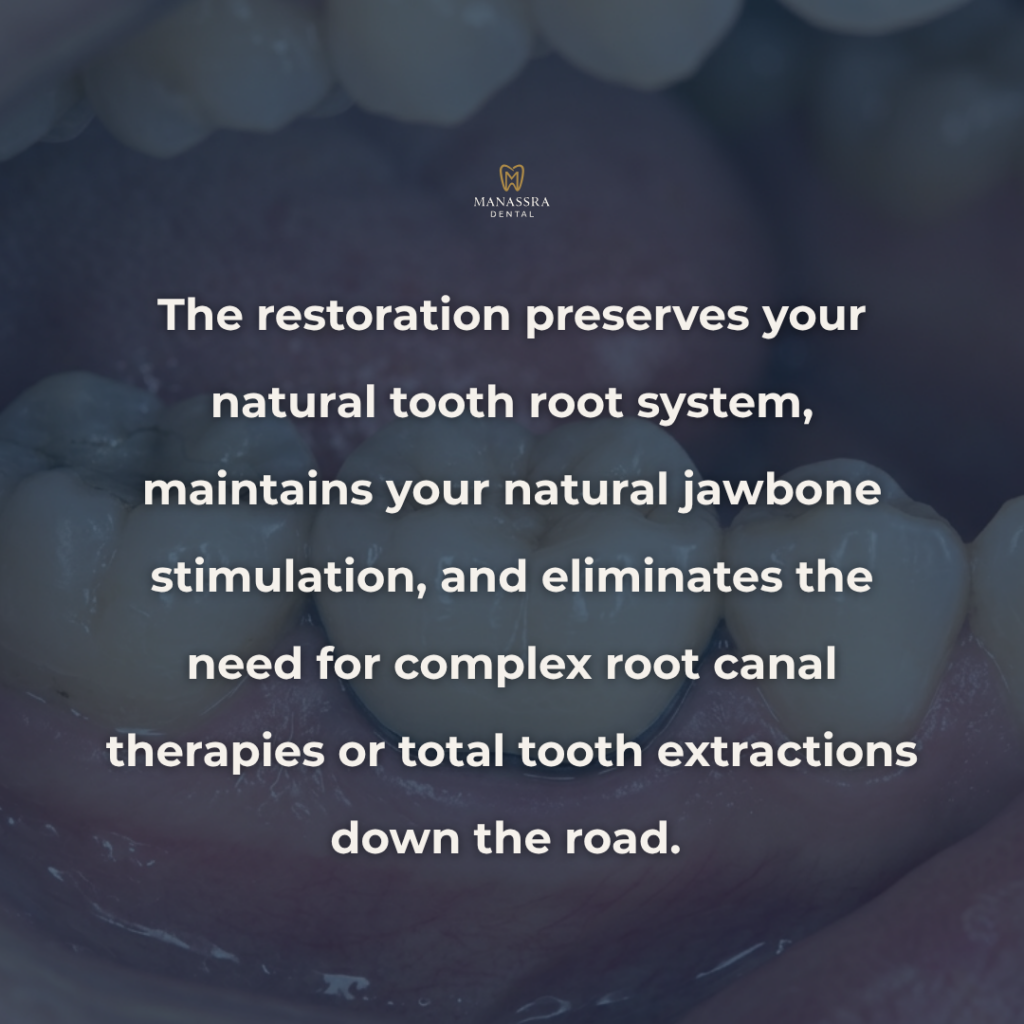
By placing a custom-engineered crown early, we completely halt this destructive cascade. The restoration preserves your natural tooth root system, maintains your natural jawbone stimulation, and eliminates the need for complex root canal therapies or total tooth extractions down the road. Preserving your natural root structure is always superior to replacing a lost tooth with artificial prosthetics, as your natural root contains specialized periodontal ligaments that provide tactile sensation and maintain bone height throughout your life.
PFM vs. All-Ceramic Systems
Choosing the right restorative material depends on your specific bite mechanics, aesthetic expectations, and where the compromised tooth is located in your mouth.
- Structural Substructure: Porcelain-Fused-to-Metal utilizes a high-strength metal alloy coping, whereas Solid Zirconia and all-ceramic systems rely on a monolithic crystalline ceramic base.
- Fracture Resistance: PFM restorations deliver exceptional fracture resistance because the internal metal framework absorbs micro-flexing under intense force. All-ceramic systems offer high strength, though they can prove more brittle if milled too thin in high-stress zones.
- Marginal Adaptation: PFM crowns feature a highly precise, cast or milled metal-to-tooth seal. Ceramic restorations utilize digitally milled ceramic margins.
- Ideal Clinical Location: PFM crowns remain the gold standard for high-stress back molars and multi-unit long bridges. All-ceramic crowns are typically preferred for high-visibility front teeth within the smile line.
- Longevity Record: PFM technology brings over 50 years of proven clinical research and data, while modern zirconia systems carry roughly 15+ years of clinical outcomes.
Restorative Dentistry Q&A
Why does a dark line sometimes appear near the gums on an older PFM crown?
That dark edge is typically the thin metal margin of the crown showing through. Over time, as a patient experiences natural, age-related gum recession, the thin metal rim that was originally hidden beneath the gumline becomes visible. While this dark shadow is an aesthetic concern, it does not indicate that the crown has failed structurally unless a clinical exam reveals a breakdown of the underlying cement seal. At Manassra Dental, we utilize advanced margin design techniques, such as porcelain butt-joint margins, to minimize or eliminate this visual metal edge whenever aesthetic demands are high.
How many appointments does it take to get a PFM crown placed?
A standard high-precision crown procedure takes two visits spaced about two weeks apart. During your first appointment, the tooth is gently shaped, a digital or physical impression is taken, and a comfortable temporary crown is placed. Our trusted dental laboratory then fabricates your custom crown. At your second visit, we remove the temporary cap and permanently bond your new, final crown into place.
Secure Your Dental Health for the Busy Season Ahead
Addressing a broken or heavily decayed tooth before it causes pain is the smartest way to preserve your natural smile. Utilizing a high-strength porcelain-fused-to-metal crown provides the perfect balance of internal structural resilience and external cosmetic appeal, keeping your underlying tooth root entirely safe from harmful bacteria and future infections. Investing in proven, high-durability restorative materials today prevents unnecessary discomfort and costly emergency treatments tomorrow.
Schedule Your Restorative Consultation in San Jose
Don’t wait for a cracked tooth or an aging, loose crown to disrupt your busy autumn schedule or holiday plans. Conveniently located here in San Jose, the high-tech team at Manassra Dental is ready to evaluate your restorative options and rebuild your bite comfort. Contact our South Bay office today to schedule your comprehensive restorative consultation!